Tuesday, December 28, 2010

First Bank of the United States

AP US History midterm is coming up, and it's scaring the crap out of me, so I'm going to summarize as many US economic events and machines up to the 20th century as I can before said midterms, posted here for your enjoyment :)  First up, the Bank of the United States!

The First Bank of the United States began operations in 1791 as part of debates forming the American constitution (and no, it has nothing to do with "Bank of America (NYSE: BAC)", which is a completely private bank).  The intention was to centralize banking operations under a main bank, which would then help smaller existing banks when decided by the government.

Operations included:
-Issuing a standard currency
-Guarding government surplus money
-Facilitating public financial transactions (such as taxes)

Currency
The currency situation was a rather hilarious ordeal which is almost another issue in itself, but ultimately the problem was that the disorganized developing nation of the US didn't have anyone in particular to assign a monetary standard.  But because people needed a place to stash their loot, private existing banks had to make their own standards just to organize their assets.

But since there were several of these private banks, each had a different currency, and financial transactions as seemingly simple as buying tea became virtually impossible.   Imagine that I paid you in euros for a product, which you would convert to yen (as per your bank) and then turn around and use yen to pay for Bob's donuts, who uses canadian dollars.  Then multiply that by several hundred thousand.  Yeah.

Thus standardizing currency under a unified government would speed up finance considerably.  Today, however, this task is performed by the Federal Reserve (aka "the Fed")

Money Storage
Since government funds would be stored in the bank, along with all private cash of the citizens, the bank could more effectively give out loans using stored capital.  This would give a far more reliable backing for that risk-filled business.  However, this would also mean that if the central bank failed, the country would fail.  It's doubtful if it would have made it through the sub-prime mortgage recession we're still feeling the effects of today.

Cons
Obviously there's a problem with the bank, otherwise it would still be around today.  The chief complaint lies in that it completely eliminates any competition in the financial sector, and we all know how much Americans hate not being able to personally control markets.  The government would be entirely responsible for corrections in the face of recessions, contrasting with republican support of state banks.

The fall
No big recession stopped the bank, its charter just expired in 1811 by one vote, only to be chartered and rechartered again later.  As I mentioned before, its remains today are the federal reserve, which just gives out loans to large businesses and prints currency.  Its supporters were chiefly northern merchants who relied heavily on frequent and simple transactions, but eyed with suspicion by southern farmers who had little need for such centralization, and only saw it as constricting their freedoms.

Phew!

Monday, August 30, 2010

Sunday, August 29, 2010

Portfolio tactics

Wow, this'll be a big one!  But since it's so general, we'll probably be changing this over time, and adding more and more stuff.

What the @#$% is a portfolio?
A portfolio is the fancy investor term meaning your collection of investments.  Thus, portfolio tactics are basically tactics to use for general investing; essentially these are rules you might do well to follow when you're buying shares.

Diversification
     Diversification:  (diˈvərsiˌfiˈkā sh ən)  noun.  The act of diversifying a portfolio.  
     Diversify:  (diˈvərsiˌfī) verb.  To purchase a wide range of stocks from different industries and
businesses.


The purpose of diversification is to prevent major losses from plaguing your investments in case of an industry crash.  And trust me, you will definitely lose some money in the stock market.  DEFINITELY.

The good news is that, unless the market is plunging into a recession, significant changes only occur in industries, such as Energy, Healthcare, and Technology.  For example, an oil shortage would mainly only affect the energy sector, since it has less goods to distribute.  Yet that hardly makes any change to the production of Apple's iSoul, but for transportation costs (indirect factors).

If you had been exclusively invested in Energy when the shortage hit, your entire portfolio would have taken a hit.  But if you average in your Conglomerates and Financial sector investments that didn't take a hit, you wouldn't suffer nearly as much!

That said, the same goes for a ridiculous growth in a single company out of the tens that you invest in;  companies with normal growth would bring down profit from your super-company.  Basically what diversification does for your portfolio is to reduce risk of failure.  It can also reduce profit, but that's your choice to make.

NEWS NEWS NEWS
Simply liking a company in general is definitely NOT a good way to invest.  If you're thinking long term, that kind of thinking helps, but you absolutely must pay attention to current events, or else your company will tank (lower in value) before you know it.  Take advantage of major events (like oil spills, maybe?  BP lost a whopping 50% in the two months after the spill!!), and the especially helpful quarterly reports, when companies tell you how much they actually sold and lost in the past three months.


More to come!

Thursday, August 26, 2010

Screw order and reason, I'm starting at the middle of the list.

Futures!


This is a pretty fun one, and it stems from your traditional stock investment; it's a Level 2 of sorts (I need to stop playing fallout 3..)  As the name suggests, a future is the same thing as purchasing any old share, BUT you gain ownership of the share in THE FUTURE.


The concept is really quite simple:  You arrange it so that you will buy a specified number of shares at a given time in the future, but you decide the price right now.  All you're doing is making a bet that by the time you gain ownership of the shares, they will be worth more than what you paid.  From then on you can just treat them as normal shares.


     Now of course now you'll ask:  "But, Oh Great and Mighty Dan, in the end this is no different from a normal investment!  You buy cheap and sell high!"  However, foolish mortals, the benefit of futures is that you will usually arrange for a share price much lower than even at the current stock price.  Nevertheless, in a normal investment, you would have had a chance to sell your shares if the company started tanking for a prolonged period of time.  If you had bought a futures contract, you'd have to wait until much later when the listed value is even lower to sell your shares.


That's all there really is to it!  Until I find a fatal flaw in this article; if I do, I'll definitely update it.  Hopefully it's good already, so..  yeah!

Friday, August 20, 2010

Outline: business administration - finance


So, we were going to blog everyday for the rest of summer.  That didn't work. No big deal.  For the last week of summer, we've got a business administration course lined up for you on [drumroll please] finance.  Topics we'll be covering include:
  • Corporate Finance
  • Capital Structure
  • Capital Budgeting
  • Mergers and Acquisitions
  • Security Analysis
  • Investments
  • Options and Futures
  • Risk Management
  • Portfolio Tactics
  • Empirical Finance
  • Financial Modelling
  • International Financial Environment
  • International Financial Management
Now who wants to guest post? :)

PS.  We don't actually understand any of these topics... yet.

Tuesday, August 10, 2010

Stocks: The more-or-less complete guide

I'm afraid that I've been misinforming you on the topic of the stock market, so I'm going to write about it again!

First of all, if you don't quite know what a stock is, go here.  Now for the good stuff!

Using Stock Price to Value a Company

As you might know, stocks show the value of a company;  multiplying stock value by the total number of shares shows you how much the company is worth if you were to buy it out this very second.

For example, Coca-Cola (NYSE: KO) is listed as $56.91 per share (share = a single piece of stock).  One share of KO is 1 / 2,310,000,000 of the total company.  So naturally, to find the company's total value, we multiply the share price by 2.31 billion, and get an estimated value of $131,000,000,000.  Of course, if you were to buy them out, you'd have to give them a few billion extra to give
them an incentive to sell.  And they don't accept visa.  (you see?  I
made a joke right there! har har har!)

How Stock Price Fluctuates

Okay, this is a biggie:  There are lots and lots (and lots) of ways that stock prices can change, and many of those are completely uncontrollable and

Saturday, May 8, 2010

No Chickens Were Harmed In the Making of This Post


I don't care what the cost is, I'm going to post another.. post.. even if it kills me (see figure 1, left)! Okay, maybe not to that extreme.

Let's talk about banks! No no, don't leave, I promise to try making this fun, really! In fact, just for you, I'll make an analogy that might work better. Just for you!

Let's imagine all the times that you gave people money so that they would pay you back. Now imagine, for the sake of argument, that they actually did pay you back. Tough concept I know, but bear with me here. Then imagine that they were even kind enough to give you something extra for the trouble of giving that fat wad of cash over to them at such short notice. That extra is the interest to your loan. And ta-da, you have more money than before!

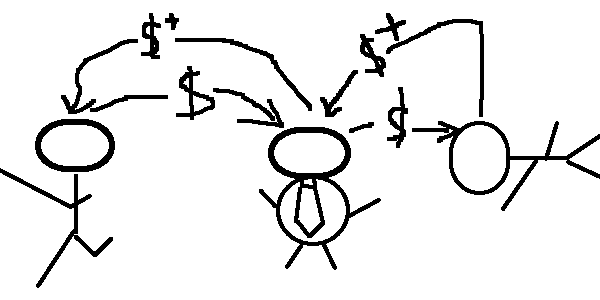
That's basically what banks try to do as much of as possible, so that they can get as much interest as possible, and make as much extra money (or profit) as possible. But in order to keep giving out money to people and get back a profit, they need lots and lots of cash (or in fancy economics terms, capital). And where do they get that money from? That's right, your savings account. If you want to get technical, they're using your money to loan yourself money. If that didn't make sense to you don't worry, since it barely makes sense to me either.

And so, that tiny little percentage of interest that you get added by the bank to your savings account is actually another tiny percent of the massive amount of interest that that banks get from loaning out your money. Remember, the profit you make from keeping your money with them is waay smaller than that profit they make from giving out your money.

And just for kicks, here's a drawing I just made to show what I just said. You are at the left, the fat one is the banker (I thought a stereotypic view might be more understandable (they're not all fat..)), and the one who is sideways is the borrower (the person that takes the loan from the bank). Oh, and the + means interest, and the one given back to you is smaller than the one given to the bank. It probably doesn't help, but I really wanted to draw it.